
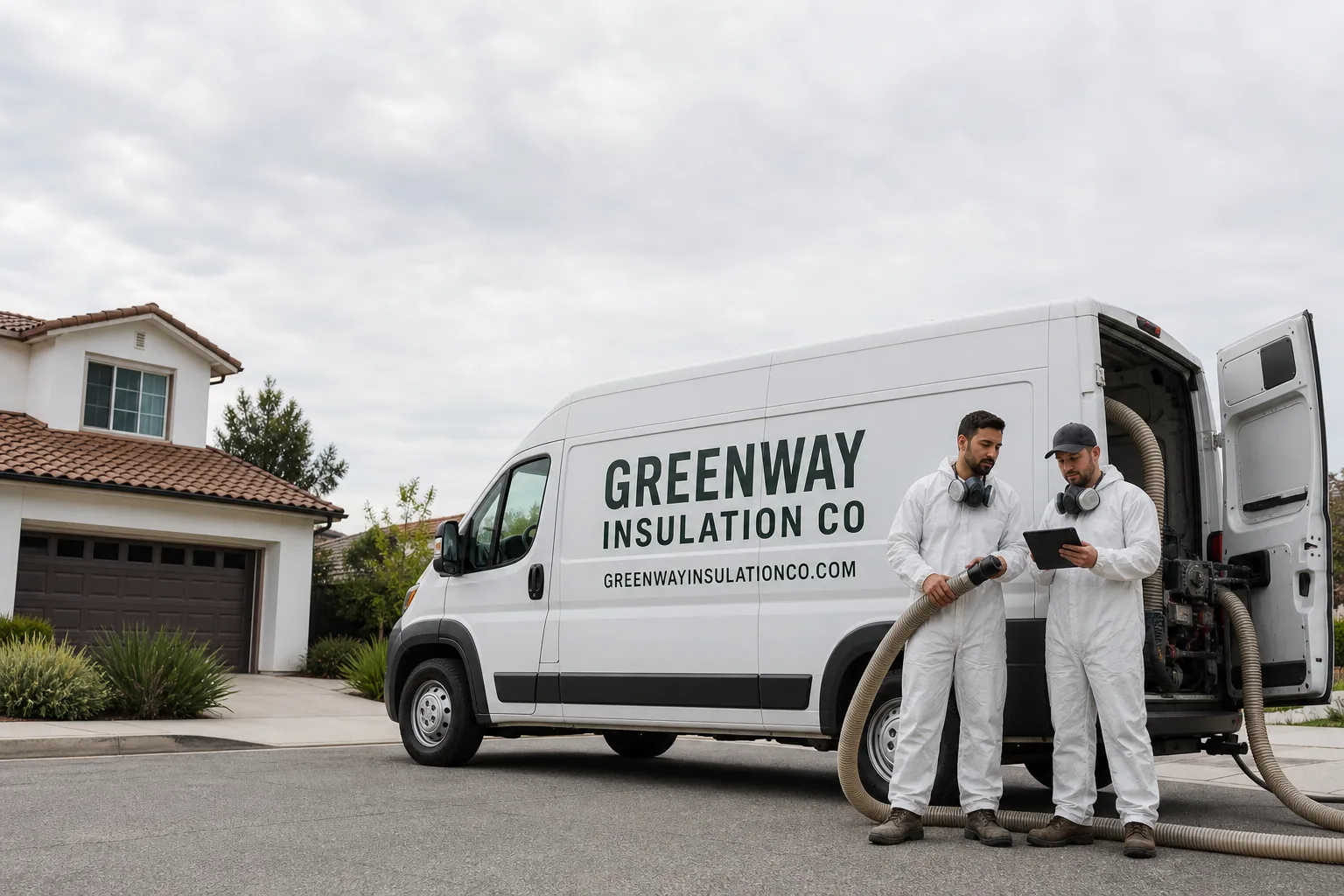
Fast, Reliable Spray Foam Insulation Across Portola Hills
Spray foam insulation in Portola Hills solves two problems at once: it air-seals the gaps that let conditioned air escape, and it creates a thermal barrier that keeps attic heat from bleeding into your living space during those 140-degree summer days. Our crews know the tract homes and hillside lots off Saddleback Ranch Road, Glenn Ranch Road, and throughout the 92610 zip code, because we’ve been working in this specific housing stock for years. Call (833) 917-5581 for a free assessment of your attic, walls, or rim joists, and we’ll tell you whether spray foam, blown-in, or a hybrid approach makes the most sense for your Portola Hills home.
Why Greenway Insulation Co Is Portola Hills’s Preferred Spray Foam Insulation Company
Most insulation contractors carry one or two product lines and will sell you whatever they stock. We install across eight manufacturers, including Icynene, Demilec, Owens Corning, and Rockwool, so the recommendation you get from us reflects what your Portola Hills home actually needs, not what’s sitting in a warehouse. Allen Beckett built this company around material matching: open-cell foam where you want sound dampening and breathability, closed-cell where you need R-value per inch and structural rigidity, mineral wool where fire resistance matters most in the wildland-urban interface.
We’ve worked in enough 1980s-era Portola Hills two-story stucco homes to know what’s behind those walls before we open them. Settled blown-in fiberglass, gaps at knee walls, cathedral ceilings with no venting path. That local experience means fewer surprises and faster assessments. Our crews are the same team whether you need spray foam, attic insulation, or blown-in, so you aren’t coordinating multiple contractors for one project.
Response time to Portola Hills is typically same-week for assessments, and we schedule installation around your availability. If your south-facing upstairs rooms are cooking in summer while the downstairs stays cold, we can diagnose whether insulation settlement, air leakage, or both are causing it.
Spray Foam Wall Insulation in Portola Hills
Spray foam wall insulation in Portola Hills is the retrofit of choice for two-story wood-frame homes where the original fiberglass batts have compressed, settled, or simply underperformed for three decades. The work involves removing or bypassing existing insulation, air-sealing top plates and penetrations, and applying either open-cell or closed-cell foam directly into the wall cavities. A typical exterior wall spray foam retrofit in Portola Hills runs $3.50 to $6.00 per square foot of wall surface, with closed-cell Icynene or Demilec at the higher end and open-cell at the lower end.
Cathedral Ceiling Wall Junctions
Where vaulted ceilings meet exterior walls, Portola Hills homes often have a gap that was never sealed at framing. Closed-cell foam works as both air barrier and insulation here, stopping the chimney effect that pulls cool air upward and out.
Knee Wall Remediation
Knee walls in upstairs bedrooms and bonus rooms are frequently under-insulated from day one. We air-seal the attic-side knee wall face and spray foam behind it, which measurably changes room comfort within a day.
Rim Joist Spray Foam in Portola Hills
Rim joist spray foam in Portola Hills addresses one of the most overlooked air leaks in any two-story home: the band board where the first-floor ceiling meets the second-floor platform. This is where unconditioned garage or crawlspace air sneaks into the house, and where mice and insects find entry points. Sealing a typical Portola Hills rim joist with closed-cell spray foam runs $900 to $1,800 depending on linear footage and accessibility. The work usually takes one day, and it is the single highest-return insulation retrofit on the mainland side of the room.
Steep Hillside Access Considerations
On downslope lots, the rim joist on the lower floor is often partially buried or hard to reach, which means we may need to access from the interior. It’s more involved, but the leak is usually worse there because the lower floor is closest to the hillside’s thermal mass.
Fire-Sealing the Band Board
Because Portola Hills sits in the wildland-urban interface, we recommend closed-cell foam for rim joists: it can act as a smoke and ember barrier in addition to its insulating function. Some homeowners pair this with Rockwool in adjacent cavities for added fire resistance.
Trusted Brands We Service in Portola Hills
We install and maintain spray foam systems from Icynene and Demilec, both open-cell and closed-cell, alongside the wider Spray Foam Insulation product family. For Portola Hills customers who ask about fire-resistant options, we also install Rockwool mineral wool in conjunction with foam in high-risk zones. Our relationship with Owens Corning means fiberglass options are available when that’s the right call. We’ll tell you which material fits your situation, then install it correctly.
Common Spray Foam Insulation Problems We See in Portola Hills Homes
- Settled blown-in fiberglass on hillside downslopes. Attics on steep lots gravity-feed loose insulation toward the low side over decades, leaving the upslope walls and knee walls bare. We remove the old material and spray foam directly against the air barrier, which doesn’t move no matter what the lot does.
- Cathedral ceilings with zero venting path. The classic 1980s Portola Hills roofline leaves no attic above the vault, so conditioned air rises and escapes through whatever gaps exist. Closed-cell foam installed between rafters creates an unvented assembly that stops the loss.
- Gaps where knee walls meet the roofline. Original framing often left a chase running from floor to roof where air moves freely. Spray foam seals that chase, and the difference shows up in the upstairs bedroom comfort within the first week.
- Aging insulation degraded by sun-driven attic temperatures. Attic heat over 140°F bakes fiberglass binder over 30 summers, and it loses loft and R-value. Before adding more insulation on top, we air-seal and, where suitable, switch to foam.
On a recent spray foam job in the Portola Hills community off Saddleback Ranch Road, we found that the original blown-in fiberglass in a 1980s two-story had settled heavily toward the downslope side of the attic, leaving the upslope knee walls nearly bare. We removed the settled fiberglass, air-sealed the top plates and rim joists with closed-cell foam, and sprayed Icynene to fill the cathedral ceiling cavities where venting is impossible – eliminating the temperature swings the homeowner had blamed on their HVAC system.
Pricing for Spray Foam Insulation in Portola Hills, CA
For a small, targeted project like a single knee wall or one rim joist section, Portola Hills homeowners can expect to spend $700 to $1,200. A full attic floor removal of settled fiberglass plus air-sealing and closed-cell foam on the knee walls and top plates typically lands between $4,200 and $7,500. A whole-home wall retrofit on a two-story stucco tract home runs $8,000 to $15,000 depending on square footage and accessibility. Your specific number depends on attic access, how much old material must be removed, and whether you choose open-cell or closed-cell. Call (833) 917-5581 for a free assessment and line-item quote.
We Also Serve Cities Near Portola Hills
If you’re just over the ridge or down the hill, we cover Foothill Ranch, Lake Forest, Laguna Woods, and Laguna Hills as part of our Orange County service area. If you’re in any of these communities, you get the same local knowledge we bring to Spray Foam Insulation in Portola Hills.
Serving Portola Hills, CA — Our Local Coverage Area
We’re based in the Portola Hills area and know this community well. Use the map below to see our service coverage — if you’re nearby, we can almost certainly help.
FAQs About Spray Foam Insulation in Portola Hills
Yes. Closed-cell spray foam specifically works in unvented cathedral ceiling assemblies because it creates an air barrier and vapor retarder in one layer, so it doesn’t need the venting path that fiberglass does. The foam fills the rafter cavity fully, stopping air movement, which is what matters when there’s no attic space to vent. Call (833) 917-5581 for an evaluation of your roofline.
The most common cause is uneven insulation settlement toward the downslope side of the attic on steep hillside lots, which leaves the upslope walls and knee walls under-insulated. Those gaps become hot and cold spots that get misdiagnosed as HVAC issues. Our assessment includes a visual attic inspection to map exactly where the insulation has shifted.
Closed-cell spray foam is not a fireproofing product, but it adds meaningful resistance to ember penetration and air leakage when installed at rim joists, eaves, and attic transitions. We also offer Rockwool mineral wool, which is non-combustible, particularly for homes on the wildland edge. For a fire-hardening plan, we’ll recommend the right combination.
Spray foam doesn’t settle. Once applied, open-cell foam and closed-cell foam hold their position and R-value for the life of the home, regardless of roof pitch or the hillside slope beneath the attic. When we remove old blown-in fiberglass and replace it with foam at the air barrier, the downslope problem stops permanently.
Yes, rim joist sealing is one of the fastest and most affordable foam retrofits. It blocks outdoor air from entering at the band board where each floor meets the rim, which is a major point of air infiltration in two-story 1980s construction. Typical cost is $900 to $1,800. Call (833) 917-5581 for a same-week assessment.
For spray foam insulation in Portola Hills, the right approach starts with knowing what’s actually happening in your attic and walls. We’ll visit, assess, and give you a material-matched recommendation and free estimate. Call (833) 917-5581.
Written by Allen Beckett, Owner at Greenway Insulation Co, serving Portola Hills with spray foam, attic, and blown-in insulation across Orange County.