Rockwool Attic Insulation in Orange: A Homeowner’s Guide
Rockwool attic insulation in Orange, CA typically costs between $1.80 and $3.10 per square foot installed, and it earns that premium through dimensional stability that fiberglass simply can’t match when attic temperatures climb past 140°F. If you’d rather not climb into a hot attic yourself, call (833) 917-5581 for a free assessment. Here’s the thing most guides won’t tell you: Rockwool isn’t the right choice for every Orange attic, and we’ll walk through exactly when it’s worth the money and when you should save it.
We pulled a Rockwool batt out of a garage conversion in Old Towne Orange last month that had been in place since 2009. It measured the same 5.5 inches as the day it was installed. Try that with a fiberglass batt after 15 years of 150°F summers and you’ll be lucky to see 4 inches. That’s the conversation that matters here.
Why Rockwool Doesn’t Sag in an Orange Attic
Southern California attics are brutal on insulation. In Orange, where summer attic temperatures routinely hit 140°F to 155°F, traditional fiberglass batts face a problem nobody talks about: the resin binder that holds the glass fibers together starts degrading under sustained heat. Over time, batts lose their loft, and when insulation loses loft, it loses R-value. A fiberglass batt rated R-30 on the package might be performing at R-22 after eight or ten years in an Orange attic, not because the material failed, but because it physically compressed and settled.
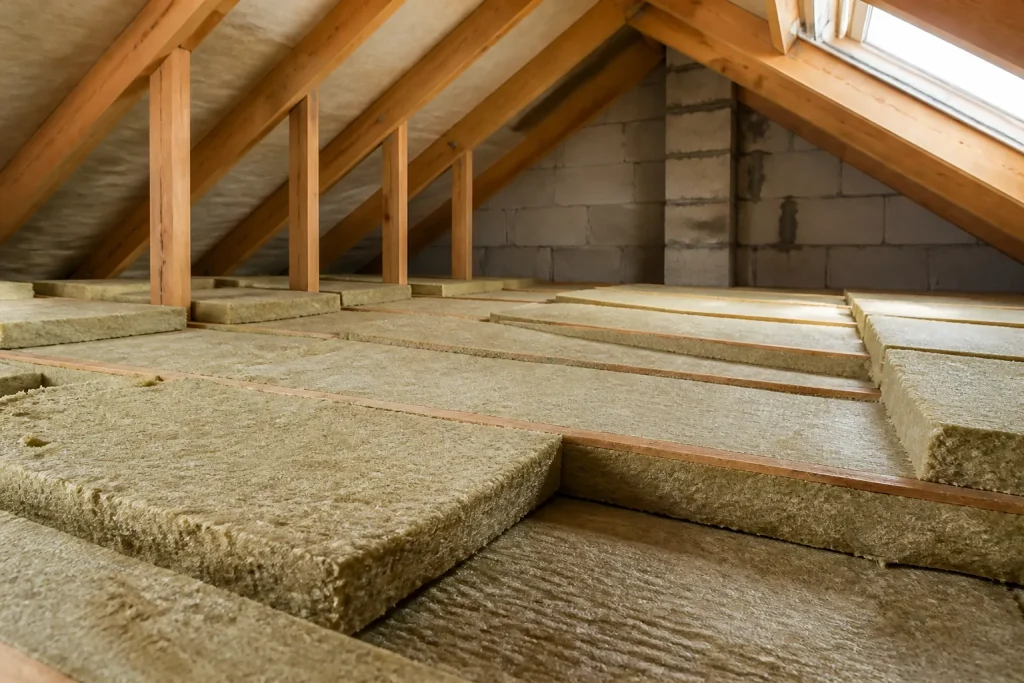
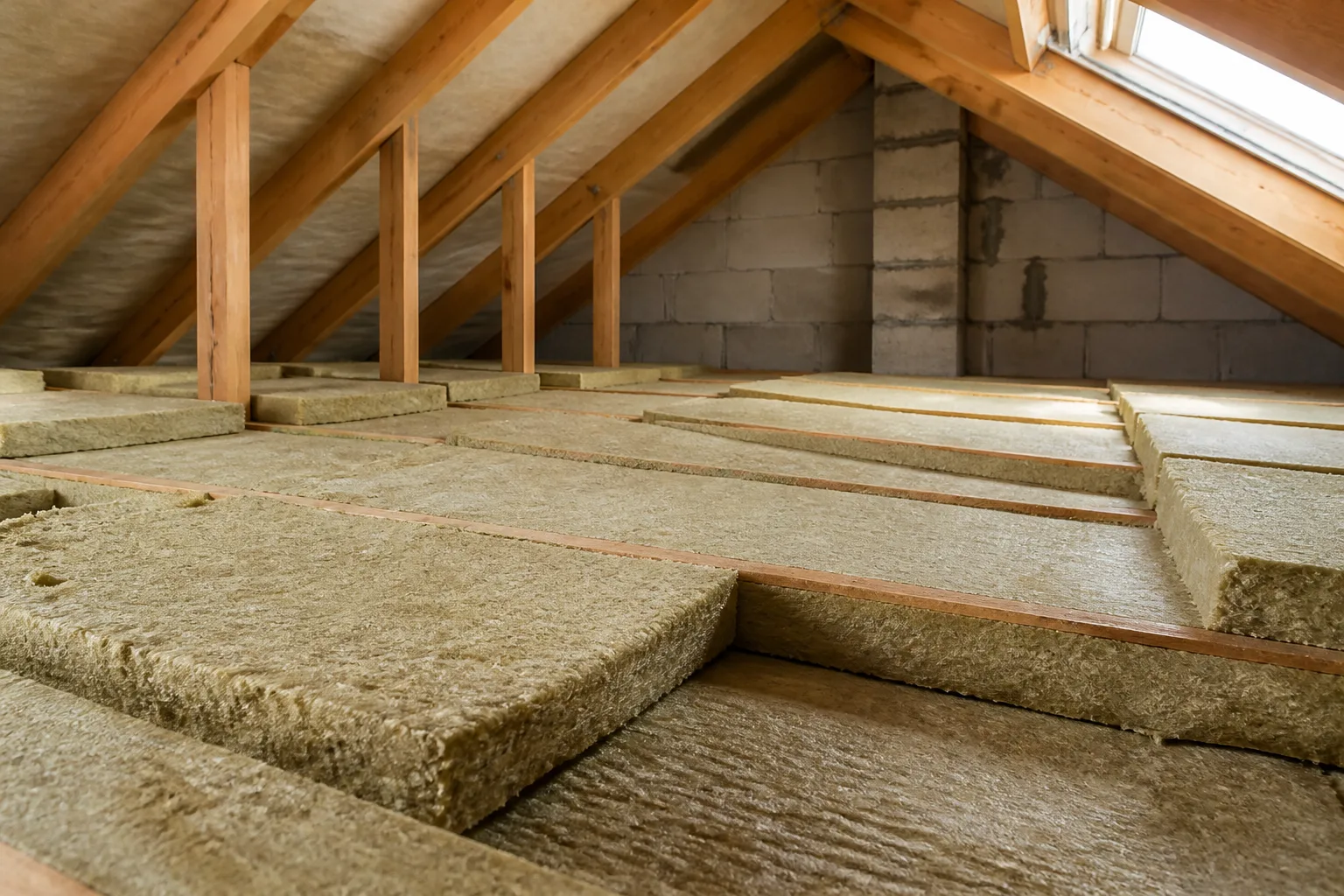
Rockwool batts are manufactured differently. The mineral wool is spun from molten basalt rock and slag, then compressed into dense, rigid batts that don’t rely on the same type of heat-sensitive binder. The result is a batt that holds its exact manufactured dimensions year after year, even when the attic above your Orange home swings from 38°F on a January night to 150°F on an August afternoon. We’ve measured Rockwool batts in attics across Orange County that were installed over a decade ago and still match their labeled thickness within a quarter inch. That dimensional stability is the real reason Rockwool outperforms, not the fire rating everyone leads with, though we’ll get to that.
For homeowners in Orange dealing with uneven second-floor temperatures, this matters more than the R-value on the bag. An R-30 batt that stays at R-30 for 20 years beats an R-38 batt that degrades to R-26 in eight. The question isn’t what the insulation does on installation day. It’s what it’s doing five summers from now.
Where Rockwool Earns Its Price in an Orange Home
Rockwool costs more than blown fiberglass and more than standard fiberglass batts. The honest math on a typical 1,200-square-foot attic in Orange: blown fiberglass installed runs roughly $1.10 to $1.60 per square foot, while Rockwool batts land between $1.80 and $3.10 per square foot depending on depth and accessibility. That’s a meaningful gap, and homeowners deserve a straight answer about when it’s justified.
Here’s where we recommend Rockwool without hesitation for Orange homes:
- Knee walls and bonus rooms: These vertical or sloped surfaces are notorious for batts sliding out of place. Rockwool’s rigidity means it stays exactly where it’s installed, and that matters in the knee-wall cavities common in Orange’s older bungalow and craftsman homes, especially those built before modern truss framing changed attic geometry.
- Cathedral ceilings and sloped rafter bays: Gravity works against fiberglass here over time. In vaulted ceiling cavities that bake in direct sun on Orange’s ridgeline homes, Rockwool’s friction fit and dimensional hold prevent the slumping that creates gaps between insulation and drywall, which is where radiant heat finds its way in.
- Attics with existing ductwork: The dense mineral wool blocks more of the radiated heat that turns your flex ducts into giant heating coils. If your attic has ducts running through unconditioned space (very common in Orange homes built in the 1970s and 1980s), keeping that airspace as cool as possible compounds the value of good insulation.
- Sound attenuation between levels: Orange’s close-set neighborhoods mean bedrooms tucked under attics, and Rockwool’s density measurably outperforms fiberglass at blocking airborne noise. If your home sits near Chapman Avenue or the 55, this is a real consideration.
For a straightforward open attic floor with standard depth, blown fiberglass still delivers more R-value per dollar, and we tell customers that plainly. The right insulation for your home, not just the one we stock.
What About Moisture and Orange’s Marine Layer?
Orange sits far enough inland that most attics stay dry year-round, but the marine layer makes its presence known in the early mornings, and homes in the western portions of the city closer to the Santa Ana River channel see measurable humidity swings. Rockwool is hydrophobic, which means it repels water rather than absorbing it. If a roof leak develops or condensation forms on the underside of a roof deck during Orange’s damp winter mornings, Rockwool won’t mat down, grow mold, or lose R-value the way fiberglass and cellulose can when they get wet.
This isn’t a license to ignore roof maintenance, and we’re not suggesting you should plan around a leaking roof. But the reality of Orange’s climate, with its dramatic swing from dry Santa Ana winds to damp marine mornings, is that attics experience wider humidity ranges than most homeowners realize. A material that shrugs off incidental moisture adds a layer of resilience that matters over the 30 or 40 years a home will carry its insulation.
One caution worth stating clearly: Rockwool’s moisture tolerance doesn’t replace proper attic ventilation. Orange homes with poor ridge or eave venting will still trap heat and moisture regardless of insulation type, and Rockwool’s density means it actually resists airflow more than fiberglass, which is either a feature or a problem depending on whether the ventilation was properly designed in the first place. If you’re unsure about your attic’s venting situation, that’s a conversation worth having before any insulation goes in. We cover this in detail on our attic insulation services page.
The Fire Rating: Real Protection, Not Just Marketing
Rockwool’s fire resistance is the feature everyone leads with, and it is legitimate. Mineral wool is manufactured from stone and does not burn, and it withstands temperatures up to 2,150°F without melting or contributing fuel. That’s not a marketing claim; it’s a material property. For Orange homeowners, the practical application is as an extra layer of passive protection in attached garages, walls shared between living spaces and mechanical rooms, and as a fire-blocking barrier in attic assemblies.
But here’s the context that most Rockwool marketing skips: your attic insulation’s job is not to put out a fire. Attic fires in Orange homes are rare, and when they do occur, the difference between Rockwool and fiberglass is measured in minutes of burn-through resistance, not any meaningful difference in occupant safety for a home with working smoke detectors and modern construction. The fire rating matters more in attached garages (where the California Building Code already requires specific separation), in multi-family construction, and in homes where homeowners want the added margin. For most single-family attics in Orange, fire resistance is a bonus, not the deciding factor. Buy Rockwool for the dimensional stability or the moisture resistance or the acoustics, and take the fire rating as a welcome extra.
Installation Reality: Why Rockwool Isn’t a DIY Job
You can buy Rockwool batts at any big-box retailer, which gives the impression that installing it is a weekend project. The material itself is genuinely DIY-friendly to handle: it cuts with a serrated knife, doesn’t itch the way fiberglass does, and fits snugly into cavities without staples. But installing it correctly in an Orange attic is a different story, for reasons that have nothing to do with the material.
The challenges are the attic itself. Working in a 140°F attic in July is dangerous, and Orange summers run hot from late May through October. The access hatches in older Orange homes are narrow, often 22 inches or smaller, which makes maneuvering 4-foot batts into tight rafter bays a genuinely difficult physical job. Air sealing needs to happen before batts go in, because no insulation performs to spec if attic air is leaking past it, and most homeowners don’t have the equipment or experience to properly identify and seal those gaps. Finally, Rockwool’s density means compression at the edges destroys its performance: a batt forced into a cavity that’s slightly too small loses the air pockets that give it R-value, and a batt that’s gapped at the edges creates thermal bypass channels that undermine the entire project.
This is where a single-crew, multi-method specialist makes sense over a general handyman. We install Rockwool, fiberglass, and spray foam depending on the application, which means the recommendation comes from what the attic actually needs rather than what happens to be on the truck. We carry products from Rockwool, Knauf, CertainTeed, and Icynene among others, and we’ll match the material to the space.
If you’re considering tackling this yourself, we’d say the same thing we tell every Orange homeowner: do the air sealing yourself if you want, crawl the attic in October, and leave the insulation installation to someone who does it every week. The savings from DIY evaporate fast if the batt goes in wrong.
Rockwool vs. Spray Foam in Orange Attics
Homeowners evaluating Rockwool often end up asking about spray foam, and the comparison deserves a straight answer. Spray foam (we install both open-cell and closed-cell through Icynene and Demilec) creates an air barrier as well as an insulation layer, which makes it the strongest performer for unconditioned attics in Orange where air leakage is the primary comfort problem. It’s also significantly more expensive than Rockwool, often two to three times the installed cost per square foot.
Rockwool occupies a middle position: better thermal performance retention than fiberglass, better moisture and sound performance than both fiberglass and standard spray foam in specific conditions, and a price point that’s accessible to homeowners who want a premium material without the full spray foam investment. In practice, many Orange attics we work on benefit from a hybrid approach: Rockwool batts in the problem areas (knee walls, sloped ceilings, partition walls) and blown-in fiberglass or blown cellulose across the open attic floor where coverage per dollar matters most. That’s not upselling; it’s material matching, and it’s the honest way to spend an insulation budget.
The Bottom Line
Rockwool attic insulation in Orange is worth the premium when you’re insulating knee walls, sloped or cathedral ceiling bays, duct-heavy attics, or spaces where sound control matters. It holds its R-value better than fiberglass in the heat extremes specific to Southern California attics, shrugs off the moisture swings Orange’s marine layer brings, and carries a fire resistance rating that’s real, even if it’s rarely the deciding factor. For open attic floors with standard depth, blown fiberglass still delivers more performance per dollar, and we’ll tell you that without hedging.
If you’re in Orange and trying to figure out which material makes sense for your specific attic, we’re happy to walk through it. Greenway Insulation Co offers free assessments, and we’ll give you the straight answer on what your home actually needs. Call (833) 917-5581 to schedule a look at your attic.
Frequently Asked Questions
Rockwool attic insulation in Orange typically runs $1.80 to $3.10 per square foot installed, depending on attic accessibility, required depth, and whether the work includes air sealing. For a standard 1,200-square-foot attic, expect a range of roughly $2,200 to $3,700 for batts alone. Call (833) 917-5581 for an exact quote based on your attic’s measurements, estimates are free.
Rockwool maintains its R-value better than fiberglass under the sustained 140°F-plus attic temperatures Orange homes experience from May through October, because its dense stone wool doesn’t compress or settle the way heat-stressed fiberglass batts do. For open attic floors, blown fiberglass still costs less per R-value, so the answer depends on where the insulation is going.
You physically can, but the dangers of working in a 140°F Orange attic and the performance losses from even minor installation errors, edge compression, or missed air sealing make DIY Rockwool a poor value. We recommend hiring a trained crew for attic work, and leaving the air sealing and batt installation to professionals who can do it safely and correctly.
Yes. Rockwool’s density measurably reduces airborne noise transmission between floors, which is particularly relevant in Orange’s close-set neighborhoods where homes sit near major roads like the 55, Chapman Avenue, or Tustin Street. If noise from above or below is a concern, Rockwool outperforms fiberglass batts and blown insulation for sound control.
Written by the team at Greenway Insulation Co, serving Orange since 2017.
Need Insulation Help?
Call Greenway Insulation Co — licensed & insured, here with fast after-hours help in Placentia.
(833) 917-5581