Attic Insulation Cost Guide: What Orange Homeowners Pay in 2026
Attic insulation in Orange, CA typically runs $2,100 to $6,800 for a standard 1,500-square-foot attic in 2026, or roughly $1.40 to $4.50 per square foot installed. That range reflects real Orange County labor rates, California disposal requirements, and Title 24 compliance costs that national estimate tools ignore entirely. If you’d rather skip the math and get a straight number for your house, call (833) 917-5581 for a free assessment.
Here’s the thing most cost guides won’t tell you: the $1.50 to $3.50 per square foot figure you’ll find on those big estimator sites is a national median. It blends Missouri labor rates with Alabama disposal fees and pretends Orange County plays by the same rules. It doesn’t. California contractor licensing overhead alone adds 15 to 25 percent to labor costs compared to the national average, and that’s before anyone opens an attic hatch. Add pre-1990 vermiculite disposal, air sealing, and Title 24 documentation, and the floor moves up before a single bag of material is opened. This guide builds the real number from the ground up.
Why Orange County Insulation Costs Run Higher Than National Averages
Orange County sits in one of the most expensive construction labor markets in the country. Licensed insulation crews here command $65 to $110 per hour, while the national median hovers around $45 to $65. That’s not price gouging. It’s the cost of doing licensed, bonded work in a market where workers’ compensation insurance, vehicle costs, and shop overhead all run well above national norms.
Then there’s disposal. Homes built before 1990 in Orange sometimes contain vermiculite insulation, which can carry trace asbestos. If testing confirms it, removal requires certified abatement contractors and sealed disposal, adding $2,000 to $5,000 to a job. Even non-hazardous old fiberglass removal runs $0.50 to $1.50 per square foot in Orange because landfill tipping fees in Southern California are among the highest in the nation. National cost calculators don’t factor in any of this.
Title 24 compliance adds another layer. Any insulation upgrade in Orange that exceeds a certain threshold triggers documentation requirements, and contractors who do it properly build that paperwork time into the bid. We’ve walked homeowners through Title 24 paperwork on hundreds of Orange attics, and the ones who thought they’d save money by skipping documentation usually end up paying more when permit issues surface during a sale or refinance.
Cost Breakdown by Material Type: What Each Option Actually Costs in Orange
Material choice matters, but not as much as most guides suggest. In Orange County, labor and access difficulty often outweigh material cost differences. Here’s what we’re seeing on real jobs in Orange in 2026, priced per square foot installed, labor and material combined:
- Blown fiberglass: $1.40 to $2.20 per square foot. Fastest install, lowest material cost, decent R-value per inch (R-2.2 to R-2.7). Good for standard attics with adequate access.
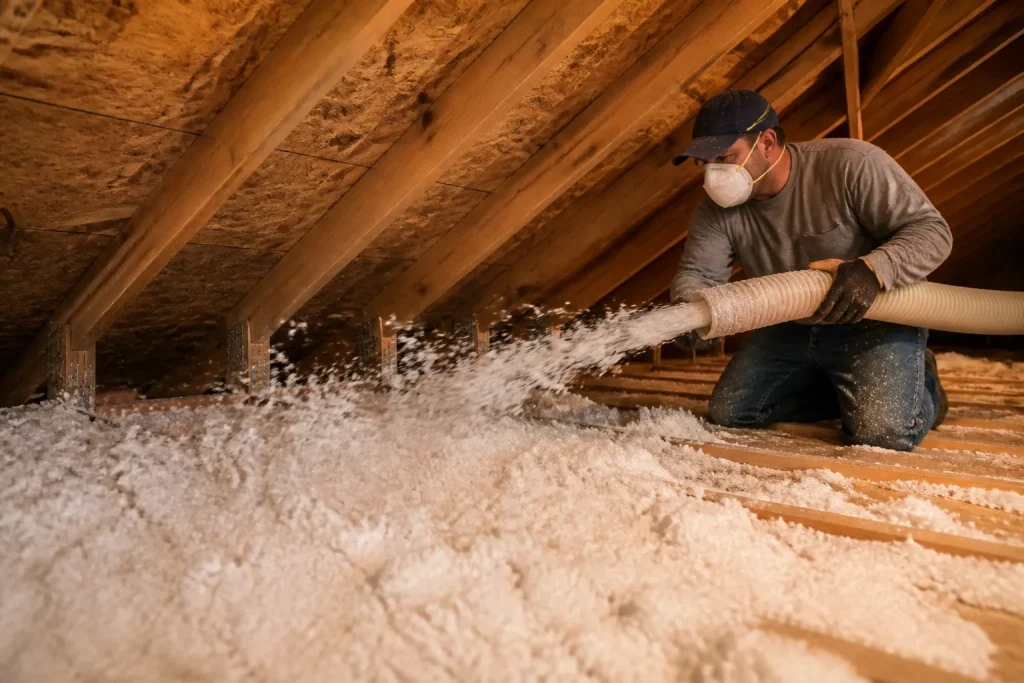
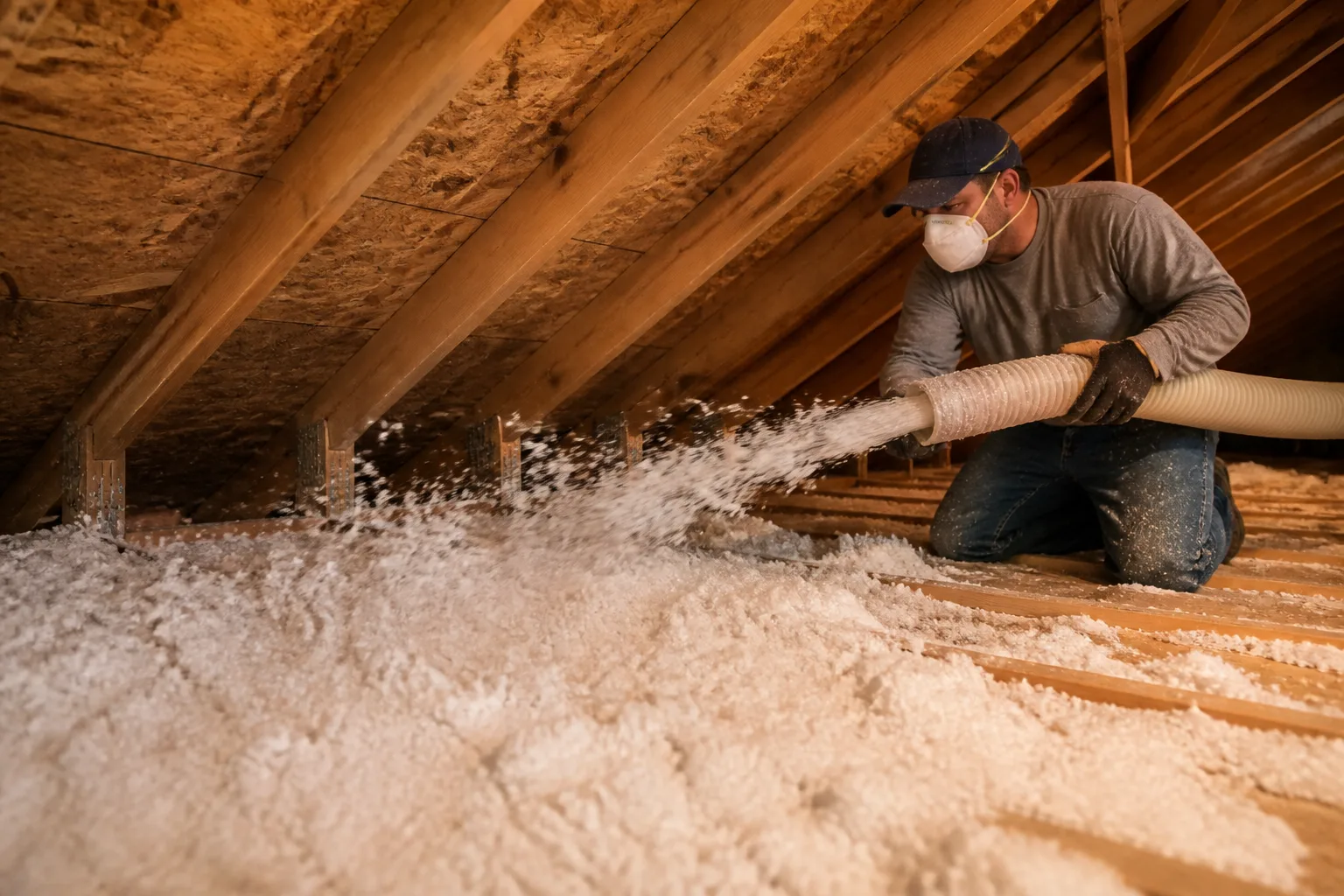
- Blown cellulose (GreenFiber): $1.60 to $2.50 per square foot. Recycled content, better air-blocking than fiberglass, R-3.2 to R-3.8 per inch. We recommend GreenFiber for Orange homeowners who want solid performance from a recycled product without paying spray foam prices.
- Blown Rockwool (mineral wool): $2.20 to $3.40 per square foot. Fire-resistant, water-repellent, excellent sound attenuation. Overkill for some attics, exactly right for others, especially in Orange neighborhoods near freeway noise.
- Open-cell spray foam: $2.80 to $4.20 per square foot. Air-seals as it insulates, R-3.6 to R-3.9 per inch. Icynene open-cell is a common choice for Orange homeowners who want the air sealing benefit without paying closed-cell prices.
- Closed-cell spray foam (Icynene or Demilec): $4.00 to $6.50 per square foot. Highest R-value per inch (R-6.5 to R-7), acts as a vapor barrier, structural rigidity bonus. The premium option, and sometimes the only right answer in tight Orange attic cavities where you need maximum R-value in minimal depth.
These are installed ranges for a typical accessible attic in Orange. Low-pitch roofs that force installers to crawl, attics with recessed can lights that need baffling, and anything requiring a full day of air sealing will push toward the top of the range or beyond.
The Hidden Line Items Every Orange Quote Should Include
The single biggest source of sticker shock in Orange insulation quotes isn’t the insulation. It’s the prep work. A responsible contractor bids these items up front. A low bid that omits them isn’t cheaper. It’s incomplete.
Old insulation removal: If your existing insulation is water-damaged, rodent-infested, or compressed to half its original R-value, it needs to come out before new material goes in. Removal and disposal in Orange runs $1 to $2 per square foot, sometimes more if the material is pre-1990 and requires testing.
Air sealing: Insulation without air sealing is like a wool sweater over a screen door. In Orange attics, common leak points include top plates, plumbing penetrations, recessed lights, and the attic hatch. Proper air sealing adds $0.50 to $1.50 per square foot and is the highest-ROI line item in the whole project. Skip it and you’ll lose 30 to 50 percent of your insulation’s performance.
Access difficulty: A walkable attic with a full-size access hatch is the best case. A low-pitch roof with 16 inches of clearance at the eaves, or an attic accessed through a closet ceiling panel, adds labor hours. Contractors in Orange will typically add 10 to 25 percent for difficult access, and honestly, that’s fair. The work is harder.
Baffles and ventilation: If your soffit vents are blocked by old insulation, installers need to add baffles before blowing new material. Figure $3 to $6 per baffle, and a typical Orange home needs 10 to 20 of them.
Rebates and Tax Credits: What Orange Homeowners Actually Get Back in 2026
Here’s the good news. California and federal programs meaningfully reduce the effective cost of insulation work in Orange, and most homeowners never claim them.
The federal 25C tax credit remains in effect for 2026, covering 30 percent of insulation material costs up to a $1,200 annual cap for insulation and air sealing. Note that’s materials only, not labor. If your Orange project includes $2,000 in insulation material, the credit is $600. It’s a meaningful offset, not a game-changer.
Southern California Edison and SoCalGas both run rebate programs for insulation and air sealing upgrades. SCE’s attic insulation rebate typically runs in the $0.15 to $0.30 per square foot range for qualifying upgrades, and SoCalGas offers similar incentives when air sealing accompanies the insulation. Combined, an Orange homeowner upgrading a 1,500-square-foot attic might claim $400 to $800 in utility rebates, plus the federal credit. That can knock 15 to 20 percent off the total bill.
We tell every Orange customer to ask their contractor whether the proposed work qualifies for these programs before signing. If a contractor can’t answer that question, that’s a signal worth paying attention to. And be realistic: these are partial offsets, not free insulation. Anyone promising the rebate programs will “pay for the whole job” is selling something.
Why Three Bids in Orange Return a Wider Spread Than Most Markets
Orange County is a competitive insulation market. That’s good for homeowners in some ways, but it also produces bid spreads that confuse people. We regularly see quotes for the same attic come in $3,000 apart. The difference is rarely material cost. It’s scope.
A low bid in Orange typically cuts corners in predictable places: no air sealing, no removal of failed insulation, no baffle work, no Title 24 documentation, thinner-than-specified depth. The job gets done fast, the check clears, and the attic looks insulated from the hatch. Six months later the bedroom still runs hot. That’s not savings. That’s deferred cost.
A high bid isn’t automatically better either. Some Orange contractors price for jobs they don’t want, or bundle premium materials where standard options would perform identically. The useful question is never “who’s cheapest” but “who specified the work the same way.” When you compare bids in Orange, line them up side by side: Does every bid include air sealing? Does every bid specify R-value achieved, not just inches blown? Does every bid include disposal? Three bids with identical scope will land within 10 percent of each other. Three bids with wildly different scopes will tell you more about the contractors than the job.
One bid we reviewed for an Orange homeowner last month came in $2,800 below the other two. The scope omitted air sealing entirely and specified R-30 where the other bids specified R-38. By the time the homeowner added those line items back in, the “cheap” bid was the most expensive of the three. That’s the pattern to watch for.
The Payback Math: What Insulation Actually Saves on Orange Utility Bills
Orange County’s climate makes insulation payback slower than in Phoenix or Minneapolis, but faster than most people assume. Summer cooling loads are significant, and SoCalGas winter heating rates have climbed steadily over the last five years. A poorly insulated Orange attic floor typically runs R-11 to R-19. Getting it to R-38 or R-49 will cut attic-driven heat gain and loss by 25 to 40 percent.
In real numbers: an Orange home with a 1,500-square-foot attic and forced-air HVAC might spend $2,800 to $4,200 a year on combined electricity and gas. Attic improvements typically reduce total HVAC load by 15 to 25 percent, which translates to $420 to $1,050 in annual savings. On a $3,500 to $5,000 insulation job with air sealing, that’s a 4 to 8 year simple payback. If rebates and tax credits knock $800 to $1,400 off the front end, payback drops to 3 to 6 years.
That’s the financial case. The comfort case is faster. In our experience across Orange neighborhoods like Orange Park Acres, El Modena, and the Plaza historic district, the most common post-installation comment we hear isn’t about the bill. It’s that the upstairs bedroom finally holds temperature. That’s the thing cost calculators can’t show you.
When to Call a Pro Instead of Going the DIY Route
Blowing insulation is not, strictly speaking, difficult. The machines are available for rent at big-box stores, and a motivated Orange homeowner with a Saturday and a helper can get material into an attic. The problem is what DIY doesn’t do. DIY doesn’t air-seal. DIY doesn’t assess whether existing insulation needs removal. DIY doesn’t know what R-value the attic actually needs for an Orange County climate. DIY doesn’t bump-test can lights or verify soffit vent baffling. And DIY rarely includes Title 24 documentation, which matters when you sell.
The professional value isn’t the blowing. It’s the assessment before the blowing and the verification after. If your Orange attic is simple, dry, sealable, and you’re confident in your air sealing work, DIY blown-in can save money. If there’s any question about moisture, old material, access, or compliance, get a professional assessment. Spray foam in particular is not a DIY product. Closed-cell foam application requires training, proper PPE, and equipment that rental counters don’t carry. If you’re considering spray foam in Orange, hire a licensed crew or don’t do it at all.
Related services in Orange: Attic Insulation in Placentia, Spray Foam Insulation in Placentia, and Blown In Insulation in Placentia.
The Bottom Line
Attic insulation in Orange costs more than the national averages suggest, but the real cost isn’t the number on the bid. It’s the number on your utility bill for the next ten years if you get it wrong. A properly specified, properly installed attic insulation job in Orange runs somewhere in the $2,100 to $6,800 range for most homes, with rebates and credits recovering $800 to $1,400 of that. Three bids with matching scope will tell you where your house falls in that range. Three bids without matching scope will just confuse you.
Greenway Insulation Co installs attic insulation, spray foam, and blown-in across Orange, using products from eight manufacturers including Icynene, Demilec, GreenFiber, and Owens Corning. That breadth means we match the material to the house rather than fitting the house to whatever we stock. If you’re in Orange and want a straight answer on what your attic actually needs, call (833) 917-5581 for a free estimate. No pressure, no upselling. We’ll tell you which material fits your situation, then install it correctly.
Frequently Asked Questions
Most Orange homeowners pay between $2,100 and $6,800 for a standard attic insulation job, depending on material type, access difficulty, and whether air sealing and old insulation removal are included. Call (833) 917-5581 for a free assessment specific to your house.
For attics with tight cavities, low-pitch access, or air leakage problems, spray foam often outperforms blown-in options significantly. Open-cell foam runs $2.80 to $4.20 per square foot installed, while closed-cell runs $4.00 to $6.50. If you can achieve target R-value with blown-in at half the cost, that’s usually the smarter spend.
Typical savings run $420 to $1,050 per year on combined electric and gas bills for a 1,500-square-foot Orange home, depending on current insulation depth and HVAC usage. Simple payback ranges from 3 to 8 years after rebates and tax credits.
Only if the existing material is water-damaged, rodent-infested, compressed, or contains pre-1990 vermiculite that tests positive for asbestos. Otherwise, new material can typically be blown over existing insulation, though air sealing should happen regardless. Removal in Orange adds $1 to $2 per square foot.
Written by the team at Greenway Insulation Co, serving Orange since 2017.
Need Insulation Help?
Call Greenway Insulation Co — licensed & insured, here with fast after-hours help in Placentia.
(833) 917-5581